A bad girl abroad: The first American travel novel

It’s not every day that one leans back in one’s chair after finishing an academic article printed 15 years ago in the scintillating Henry James Review and says “Holy shit.” But today is indeed such a day, dear readers. Because hot damn, I found some history.

Sarah Wadsworth is an English professor at Marquette University in Wisconsin, and waaaay back in 2001 she wrote an article tracing the roots of Henry James’s interest in American women getting into trouble in Europe. Among his many accolades, James gets the credit for “inventing” the literary trope of the American ingenue abroad.

But get this: The first “travel novel” featuring an American woman as its protagonist is actually Mary Murdoch Mason’s Mae Madden: A Story, about a young woman’s love triangle in Rome. Wadsworth argues that Mae Madden was probably the inspiration for James’s Daisy Miller, which more or less put him on the map. Daisy Miller is about “an impossibly well-dressed American girl” and her romantic entanglements in Rome, and the plots of the two books track pretty closely. Mae Madden was first published in 1875 and again in 1876. Daisy Miller appeared in 1878.

Mason’s novel is significant because she broke with the popular trend of writing about one’s real travels in painstaking detail. “The concern that ‘there is nothing new to tell’ was evidently a common one in the 1870s, when the popularity of American women’s travel writing was at its peak,” wrote Wadsworth. So instead of just publishing a diary about her time in Italy like her peers did, Mason turned her experiences into a fictional story!

I cannot emphasize enough how big of a shift this was for American travel writing.Read More »
We’re up to 50!

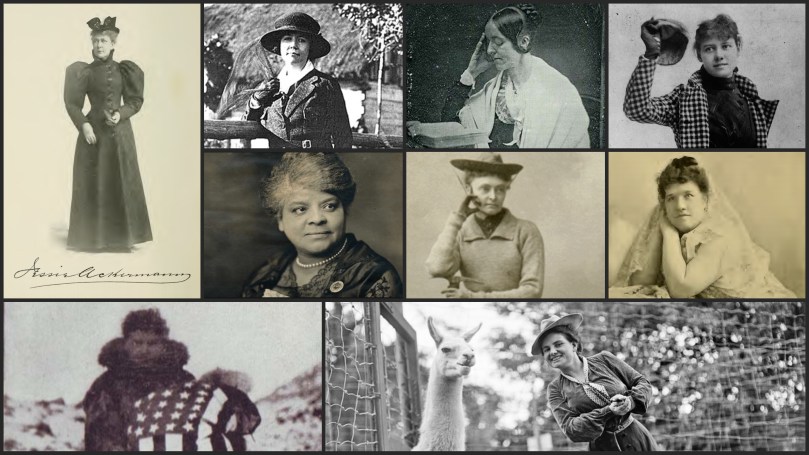
I hit an arbitrary milestone today: 50 women on my list of American women travelers from the 19th and early 20th centuries.

War reporters, scientists, artists, homemakers — it’s a diverse list that challenges some of our stereotypes about what women were up to in decades before and right after they obtained the right to vote. And it’s far from complete. My goal is 100 women, but I can’t get there alone. Know a name I don’t? Tell me all about her.

In the coming weeks, I’m going to start breaking down the comprehensive list into smaller, more thematic ones, like “WWI war correspondents,” or “schoolteachers abroad,” etc. And my posts will start to delve a little deeper into various topics that this list brought to light, such as the “royal road” through Europe that lots of American women followed in the 1880s and common ways in which “lady travel books” were marketed around 1900 (popular ad copy adjectives included “wide-awake traveler” and “breezy narrative”). I could also spend a lot of time on packing advice and media coverage of the controversial clothing choices of women in the 1910s.

Anyway. After a lot of time poking around the Internet in pursuit of historical women, I think we’re finally cookin’ with gas here on WR. Thanks for being an early reader!

early-travelers

Travel Tips from 1890

Mary Elizabeth McGrath Blake was totally over your packaged vacation to Europe. In, um, 1890.

Best remembered as a poet, Boston-based Blake also wrote three travel books, two of which were about international journeys. All three open with striking commentaries about the “travel trend” in 1880s America, but the introduction to A Summer Holiday in Europe is arguably the most powerful.

Blake drops some serious real talk here. Her advice boils down to this:

  • Get over yourself while on the road. No really, you don’t turn into a queen the second you show up somewhere new. So be nice to the locals.
  • Stop pretending your limited income is why you’re not traveling.
  • Pack light — no seriously, pack really, really light.
  • Bring a flask.
  • Sleep. For the love of god, sleep. Otherwise, you’ll forget everything you see and your whole trip will go to waste.
  • Remember, it’s all worth it, because without travel, you’ll never know Who You Are.

Read the whole thing for yourself, because really, no one can say it better than Blake:Read More »

Just the facts, ma’am: Resources on Harriet Bell Merrill

We don’t know much about limnologist and Amazon traveler Harriet Bell Merrill, but what we do know is very much at risk of an impending Error 404 error.

yerbe-mate
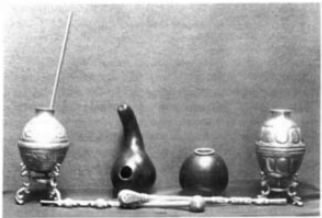
Amazonian yerbe mate cups Merrill donated to the Milwaukee Public Museum

Merrill was one of the first limnologists in the country, and possibly the first female limnologist to be hired by an American university (the University of Wisconsin). She was an expert in tiny, algae-eating lake crustaceans known as Cladocera, and she went above and beyond the call of duty by traveling twice to South America to conduct fieldwork (1902-1903 and 1907-1909). Unfortunately, she died as her career was peaking, and for the next 75 years, she was almost entirely forgotten by her field. But in the 1990s, her grandniece brought her out of total obscurity by publishing a biography, and the University of Illinois stepped up to preserve her papers.

Why do we care? Well, Merrill kept remarkably detailed journals and wrote A LOT of letters to her friends, not only about her scientific work, but also vivid descriptions of Brazil and about the cultures she encountered during her fieldwork. She brought back South American items for Wisconsin museums, and some of her travel stories were published in a local newspaper. Her solo journeys were all the more unique because she was in ill-health for the better part of her adult life.

Read More »

What is it I do seek, what thing I lack?

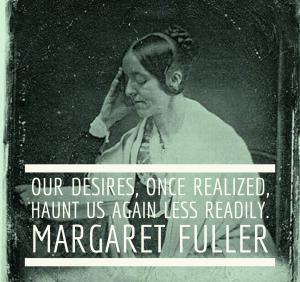
Margaret FullerWhy do we travel? What are we missing that we hope to find so far from home? Margaret Fuller, the first female American journalist to work as a foreign correspondent, has some thoughts on the matter.
Fuller wrote from England and Italy for The New York Tribune from 1846 to 1850, when she died with her family in a shipwreck on her way back to the States. This partial poem is from Summer on the Lakes, an earlier, hard-to-classify work about her time exploring the Great Lakes, then considered the American frontier:Read More »

The Reluctant Traveler: Elizabeth Bisland overcame her very public loss to Nellie Bly

Elizabeth BislandSometimes we don’t get to choose the journeys we take. Or even have time to pack.

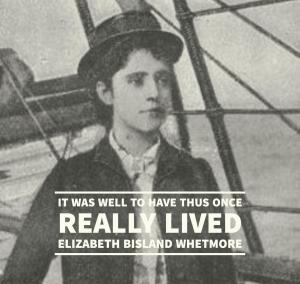
Elizabeth Bisland Whetmore was drafted into service by The Cosmopolitan to compete with Nellie Bly’s 1889 stunt to travel around the world in under 80 days for the New York World. (Bly completed the journey in 72 days; then-Bisland took 76.)

Even a quick skim of Bisland Whetmore’s book about her trip, In Seven Stages: A Flying Trip Around the World, makes it clear that her heart wasn’t in it. She’d never before traveled abroad, and much of her account is fixated on complaining about her (lack of) luggage, recounting inane logistics of the journey, and commenting on her un-photogenic traveling companions.

I mean, seriously, she opens the book with a detailed description of the morning she found out about the trip, complete with a reference to her bowel movement. I shit you not:Read More »

Why this blog exists, or, Have you met Mickey?

It started simply enough. In 2013, I was sitting in a lonely office in a lonely wing of the engineering building on the University of Wisconsin campus. At the time, I was a science writer, on the hunt for a historical factoid about materials science to insert into a department newsletter.

I stumbled across the name of the first female graduate of the program: Emily Hahn. She received her degree in 1926, but the college’s website offered nothing more. I mentioned Hahn to my boss, who shrugged and said, “I don’t think she became an engineer.” I didn’t include her in the newsletter.

But I didn’t forget her, and eventually, I started to Google her. And it didn’t take long to realize that “Mickey” Hahn was way more interesting than we gave her credit for.

After a brief stint as a mining engineer, she became a writer and world traveler, ultimately producing more than 50 books. She traveled to the Belgian Congo alone in her mid-20s, and she spent eight years in Japan-occupied China during WWII.

I was … stunned. I’d majored in journalism at the University of Wisconsin, and I’d never, not once, heard the name of this prolific alum. How was that possible?Read More »